By Rui Xu, Founder of MyHomeScout
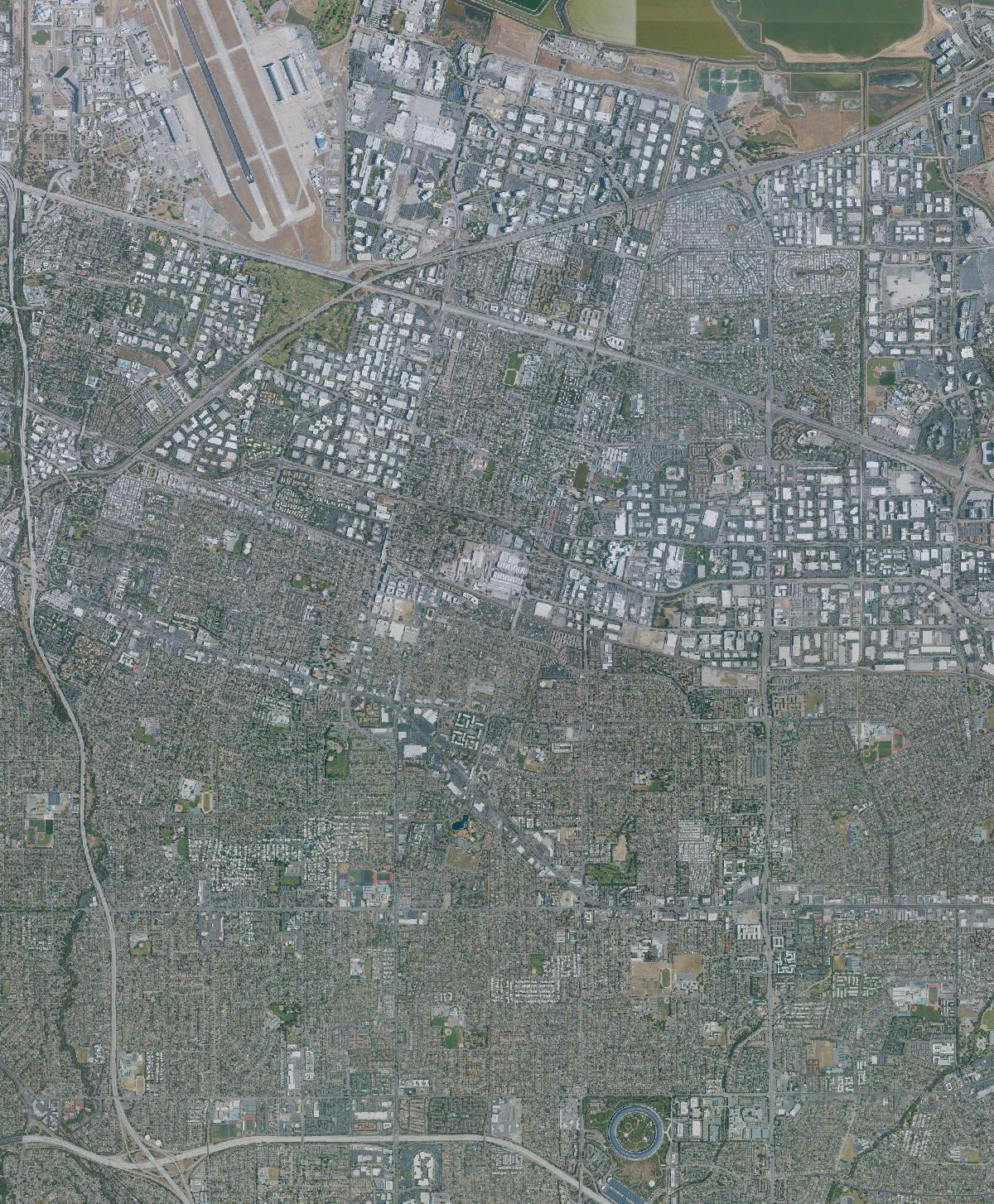
- Within half a mile of a major transit stop. State law (AB 2097) already bars parking minimums here. Dashed: stops in Mountain View and Santa Clara.
- Downtown, Lawrence Station and El Camino Real plan areas. The proposal removes their minimums.
- City limits. Everywhere else the citywide rule applies: a new house needs 4 spaces today, 2 under the proposal.
- A–C: the three projects compared below.
- 1. Sunnyvale Caltrain station
- 2. Lawrence Caltrain station
- 3. Moffett Park light rail
- 4. Lockheed Martin light rail
- 5. Borregas light rail
- 6. Crossman light rail
- 7. Fair Oaks light rail
- 8. Vienna light rail
- 9. Reamwood light rail
- 10. El Camino Real at Sunnyvale-Saratoga Rd (bus)
- A. 8 houses, South Wolfe Rd
- B. 137 townhomes, Kifer Rd
- C. 543 apartments, Humboldt Ct
Short answer: Every new single-family house in Sunnyvale must have four parking spaces, two of them covered, whatever its size. Of the 22 nearby cities in the city's own comparison, only three ask that of every house. A rewrite of the city's parking code would cut it to two, drop minimums in Downtown, Lawrence Station and along El Camino Real, and end a rule that forced some remodels to add a garage space. The Planning Commission recommended it 5–2 on November 9. The City Council takes it up on December 1. Near Caltrain and light rail, state law already bars parking minimums, so we mapped where the city's rule still decides. It covers 91% of the lots zoned for houses.
I build MyHomeScout, which sells property-data tools to home buyers and agents. We do not represent buyers or sellers, and no developer or city paid for this. Every figure below comes from the City of Sunnyvale's staff reports, minutes and project files, its public GIS maps, and Census estimates the city compiled, read on November 19, 2026. Exact addresses are in the linked project files.
- 4 → 2: parking spaces a new single-family house must have, today and under the proposal
- 91%: of the 19,845 lots zoned for houses are more than half a mile from a major transit stop, where the city's own rule decides
- 46.2%: of Sunnyvale households have one car or none, up from 40.0% five years earlier
- 5–2: Planning Commission vote to recommend the rewrite, Nov. 9
Four spaces for every house
On September 14 the Planning Commission approved eight two-story houses on half an acre of South Wolfe Road. The project's data table lists the parking for each one: two covered spaces, two uncovered. The builder did not choose four. Four is the minimum Sunnyvale's code sets for every new single-family house, from a starter home to a mansion.
The city's staff compared that rule with 22 other Bay Area cities as of September 2026. For a typical new four-bedroom, 2,400 sq ft house, here is what each one requires:
| spaces | Cities |
|---|---|
| 4 | Sunnyvale today, Cupertino, Daly City (2,001–2,500 sq ft), Los Altos Hills, Monte Sereno |
| 3 | Milpitas (4 bedrooms) |
| 2 | Sunnyvale proposal, Concord, Fremont, Gilroy, Hayward, Los Altos, Los Gatos, Morgan Hill, Mountain View, Palo Alto, Richmond, San Mateo, Santa Clara, Saratoga, Walnut Creek |
| 1.5 | Redwood City |
| 0 | Alameda, San Jose |
Source: the city's comparison of 22 cities, Attachment 12 to the Nov. 9 staff report (as of September 2026).
Uncovered spaces are the unusual part. Only Sunnyvale, Cupertino and Monte Sereno require them at all. Most cities count the garage and stop there.
What the rewrite changes
The Council opened this study in 2019. In March 2024 it told staff to draft code changes. The result repeals and replaces Chapter 19.46 of the zoning code, the parking chapter, and amends the Downtown, Lawrence Station and El Camino Real plans. Staff say the aim is to lower development costs, help housing get built and catch the code up with state law.
| Rule | Today | Proposal |
|---|---|---|
| Houses and duplexes | ||
| New single-family house | 4: 2 covered, 2 uncovered | 2, covered or not |
| Duplex, per unit | 2 | 1 |
| Remodel reaching 4 bedrooms or 1,800 sq ft, with under two covered spaces | Must add covered spaces up to 2 | Rule removed (state law AB 1308 already limits it) |
| Tandem (one car behind another) | Only on lots 57 ft wide or less | Allowed on any lot |
| New lots with no street parking in front | +0.4 shared space per home | +0.25 |
| Apartments, condos and townhomes, citywide | ||
| Studio or 1 bedroom | 1.5 to 2.25 | 1 |
| 2 bedrooms | 2 to 2.4 | 1.5 |
| 3 bedrooms | 2 to 2.5 | 1.5 |
| 4 or more bedrooms | 2.15 to 2.65 | 2 |
| Guest parking | Set project by project | 0.25 per home, at least 1 |
| Extra spaces where street parking is short | At the city's discretion | Removed |
| Tandem in townhomes | Up to 50% of assigned spaces | Allowed for all |
| Compact spaces | Up to 10% of unassigned | Up to 20% of all |
| Plan areas | ||
| Downtown | Minimums | No minimum; new maximums |
| Lawrence Station | Minimums and maximums | No minimum |
| El Camino Real | Minimums and maximums | No minimum; maximums aligned |
| Moffett Park, Lakeside, 101/Lawrence, Village Centers | Own rules | No change |
| Set by state law | ||
| Backyard units (ADUs) | None required | No change |
| SB 9 lot splits and duplexes | Up to 1 per unit; none near transit | No change |
Source: Nov. 9 staff report and its Attachments 13 and 15. Apartment numbers are for projects outside plan areas and transit zones that do not use the state density bonus, which already caps parking lower.
Two changes reach existing homeowners, not just builders.
The garage upgrade. Today, if a house has fewer than two covered spaces and a remodel brings it to four bedrooms or 1,800 sq ft, the owner must add covered parking until there are two spaces. A 2023 state law, AB 1308, already exempts most such remodels that stay within the city's size limits. The rewrite removes the local rule. Staff say the change lets owners expand without fitting four spaces on the lot, and leaves more room for ADUs and extended families.
Tandem parking. One car parked behind another counts today only on lots 57 feet wide or narrower. The rewrite allows it on any house, duplex or townhome lot.
Some things do not change. Backyard units (ADUs) need no parking under state law. SB 9 lot splits need at most one space per unit, and none near transit. Moffett Park keeps its own rules, which cap parking rather than require it.
Where the city's rule still decides
The map at the top of this story shows why the rewrite matters more for houses than for apartments.
In 2022 the state passed AB 2097, which bars cities from imposing parking minimums on most new development within half a mile of a major transit stop. A 2024 law, AB 2553, widened which bus stops count. The city's map lists ten such stops in Sunnyvale: two Caltrain stations, seven VTA light rail stations in north Sunnyvale, and El Camino Real at Sunnyvale-Saratoga Road. Inside those circles, a builder can already put in as little parking as it wants.
We laid the circles over the city's zoning and parcel maps. All of Downtown is inside them. So is about two-thirds of the Lawrence Station plan area by land, and about a third of El Camino Real. For apartments, staff say the cut in minimums would have limited effect, because plan areas, transit circles and the state density bonus already lower parking for most projects.
The neighborhoods are different. Of the 19,845 lots zoned for houses, 1,737 (8.8%) sit within half a mile of a major stop. The other 18,108, including most of the neighborhoods south of El Camino Real, are where the four-space rule applies. That is the rule the Council would change. Duplex-zoned lots are closer to transit: 28% of 3,295 are inside a circle.
Fewer cars per household
The staff report leans on Census estimates the city compiled. From 2019 to 2024, Sunnyvale's population grew about 1% while occupied homes grew 7.5%. The average household shrank from 2.71 people to 2.54. Households with one car or none rose from 40.0% to 46.2%.
| Place | Households with 0 or 1 car |
|---|---|
| San Francisco (no minimums) | 74.3% |
| Mountain View | 52.8% |
| Walnut Creek | 50.5% |
| Alameda (no minimums) | 48.9% |
| Sunnyvale | 46.2% |
| Santa Clara | 45.2% |
| Palo Alto | 44.1% |
| Santa Clara County | 37.0% |
| San Jose (no minimums) | 35.9% |
| Cupertino | 32.3% |
Source: American Community Survey five-year estimates (tables S2504 and S1101), compiled in Attachments 7 and 8 to the Nov. 9 staff report. Each bar adds the shares with no car and one car; Alameda's figure is as the staff report states it.
Staff single out Alameda, which repealed parking minimums citywide in 2021. Its average household is the same size as Sunnyvale's, 2.53 people, and 48.9% of its households have fewer than two cars. Staff also say these trends cannot set the right number of spaces for a given building on their own.
Three projects, three sets of rules
The year's project files show how much the rules differ across the city:
Three projects, three parking regimes
| No. | Project | Where | Homes | Details |
|---|---|---|---|---|
| A | Eight houses on South Wolfe Road | South of El Camino Real, a mile from the nearest major stop | 8 houses | Rule: Citywide; Required: 4 per house: 2 in garages, 2 on driveways (32); Under the proposal: 2 per house (16); Approved: Planning Commission, Sept. 14 |
| B | 137 townhomes on Kifer Road | Lawrence Station plan area, 0.8 mile from the station; replaces a 96,410 sq ft industrial building | 137 townhomes | Rule: Lawrence Station plan; Required: At least 230; it provides 244; Tandem: 52.9% of spaces, above the 50% cap; approved as a deviation; Under the proposal: No minimum; tandem allowed |
| C | 543 apartments on Humboldt Court | Moffett Park, 0.3 mile from Borregas light rail; replaces a vacant 50,000 sq ft office | 543 apartments | Rule: Moffett Park plan: at most 1 per home; Proposed: 543 resident spaces + 11 guest; Rented separately: Every space, as state law requires for rentals of 16+ units; Under the proposal: No change |
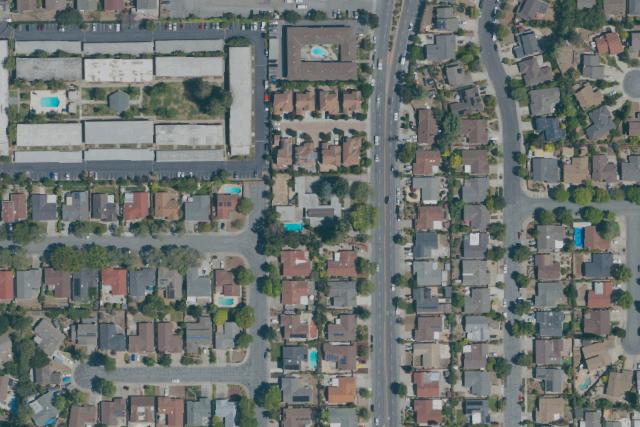
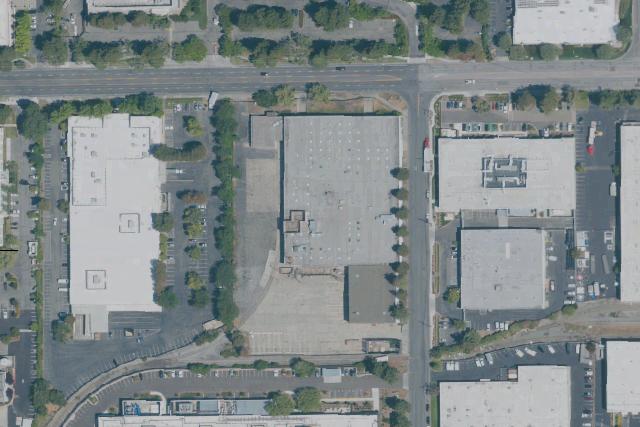
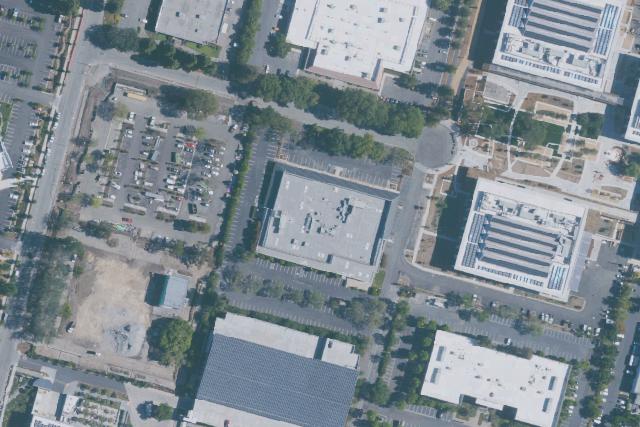
Aerials: USDA NAIP, May 19, 2022 (public domain). The ring marks the site. Parking figures are from each project's data table and description letter.
A. South Wolfe Road sits under the citywide rule: four spaces per house, 32 in all. Under the rewrite, 16 would meet the minimum. The builder could still provide more.
B. Kifer Road is in the Lawrence Station plan area but 0.8 mile from the station, outside its circle. City Ventures is replacing a 96,410 sq ft industrial building with 137 townhomes. The plan required at least 230 spaces, and the project provides 244. Its tandem share, 52.9%, exceeded the 50% cap and was approved as a deviation. At the August 24 hearing, several commissioners said they would have liked more homes on the site. The developer said a public path the plan requires took the room more homes would have needed. Under the rewrite there would be no minimum, and tandem spaces would be allowed for townhomes.
C. Humboldt Court is in Moffett Park, 0.3 mile from Borregas light rail. TruAmerica proposes 543 apartments in two buildings to replace a vacant office: 356 mixed-income homes and 187 restricted to lower-income households. Moffett Park caps residential parking at one space per home. The project proposes exactly 543 resident spaces plus 11 for guests, every one rented separately from the apartment. State law requires that separation for new rentals of 16 or more homes in Santa Clara County. The Planning Commission hears it on November 23. The rewrite does not change Moffett Park.
The tradeoff
Less required parking "may also increase demand for on-street parking in some neighborhoods."
City of Sunnyvale staff report to the Planning Commission, November 9, 2026
Staff state the tradeoff plainly: less required parking can lower housing costs and free up land, and some of those cars move to the street. The rewrite keeps a guest-parking minimum for apartments, a quarter space per home and at least one. It drops the rule that let the city demand extra spaces where street parking is short. It does not deal with street parking, permits or enforcement. Staff list those as future work, along with a fuller review of the city's program for cutting car trips.
Neighbors raise the same point project by project. When 30 townhomes on South Wolfe Road came before the Commission in September, neighbors wrote asking for three spaces per home plus guest parking. The project provides 63 spaces where 58 were required.
At the November 9 hearing, the Commission voted 5–2 to recommend the rewrite. Commissioners Chris Figone and Ilan Sigura voted no. The majority added two requests. They asked the Council to start a program to "actively manage" all city-provided parking, and to track car ownership over time to measure the effect. Public turnout was small. Nine people attended the September online meeting, and eight had written in by the time the staff report came out.
- 2019 Council opens a study of the city's parking rules
- 2022 Scope narrowed to parking for housing
- Mar. 19, 2024 Council tells staff to draft the code changes and ask the public
- Sept. 30, 2026 Online community meeting; nine residents attend (Eight people had sent written comments by the time the staff report came out)
- Nov. 9 Planning Commission recommends it, 5–2, and adds two asks (Manage city-owned parking citywide; track car ownership over time)
- Nov. 10 Council moves its hearing to Dec. 1 (6–0, one absent)
- Dec. 1 Council hearing and first vote (Written comments: council@sunnyvale.ca.gov, at least 4 hours before the meeting)
- Later A second vote adopts it; it takes effect 30 days after that
If you own, are buying or are building
- Nothing changes for an existing house. The rules apply to new homes, and to additions and remodels that need a permit.
- Planning to remodel past four bedrooms or 1,800 sq ft with a one-car garage? Ask the planning desk how AB 1308 applies to your plans now. If the rewrite passes, the local upgrade rule is gone.
- Buying near a station or Downtown? New buildings there can already go up with little or no parking. Walk the block on a weeknight evening and see how full the curb is.
- Buying next to a lot that could be redeveloped? Find it on the map above. Whether it sits in a circle, a plan area or the rest of the city decides how much parking a project there has to include.
- Want a say? The Council hearing is December 1. Email written comments to council@sunnyvale.ca.gov at least four hours before the meeting, or speak in person or online.
Watching a Sunnyvale address? Check it free on MyHomeScout, and follow new items on Sunnyvale city hall, which reads the city's agendas every 6 hours.
How we did this
We read the November 9 Planning Commission staff report, its attachments and the draft ordinance. We also read the votes and minutes from the November 9 Commission and November 10 Council meetings, and the data tables and letters for the projects named here, all from the city's Legistar system.
For the map and lot counts, on November 19, 2026, we downloaded Sunnyvale's zoning districts, specific-plan boundaries and 31,980 parcels from the city's public GIS. We drew straight-line half-mile circles around the ten major transit stops the city identifies. We added four stops in Mountain View and Santa Clara whose circles reach into Sunnyvale. Each parcel was counted under the zoning district at its center. "Lots zoned for houses" are parcels in the R-0, R-1, R-1.5 and R-1.7 districts, and a few of them are common areas.
Limits: the legal test for whether a project is within half a mile can differ from a circle drawn around a stop. The Council has not voted, and the ordinance could change on December 1.
Sources (read November 19, 2026): City of Sunnyvale, Planning Commission staff report, November 9, 2026 (RTC 26-0803), with its presentation, draft ordinance, demographic and vehicle trends, peer-city vehicle comparison, state laws, zoning and transit-stop map, single-family peer comparison, current and proposed apartment parking, other parking changes and future study items; Planning Commission meeting, November 9; City Council meeting, November 10; project data tables for South Wolfe Road, eight houses, Kifer Road and South Wolfe Road, 30 townhomes; Humboldt Court project description; Planning Commission meeting, August 24; City of Sunnyvale GIS services (zoning, specific plans, parcels).
Disclaimer:This article is for general information only and is not legal, tax, insurance, or other professional advice. Confirm official records and consult the appropriate professional before you decide.